Why Did My Career Stall? The Answer Zig Ziglar Already Knew by Ken Gould
By Ken Gould, Fractional COO | May 2026
"If standard of living is your major objective, quality of life almost never improves. But if quality of life is your number one objective, your standard of living almost always improves."— Zig Ziglar
Zig spent decades saying that.
Most people nodded and moved on. Then went right back to negotiating for the bigger number.
I've spent more than 25 years in operations and leadership across multiple industries and continents. One thing has held true across all of it: Ziglar was right.
The professionals who built careers worth talking about were almost never the ones chasing the paycheck. They were building something deeper. The money came. It nearly always does when you get the sequence right.
The ones who stalled were the ones who got the sequence backwards.
The Numbers Set the Stage
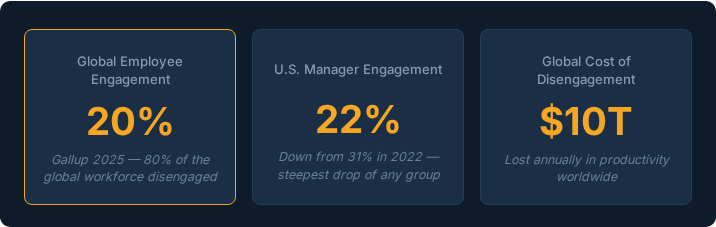
In 2025, only 20% of employees worldwide reported being engaged at work, according to Gallup's annual State of the Global Workplace report. That is 80% of the global workforce going through the motions or actively pulling in the wrong direction. Poor engagement now costs the global economy approximately $10 trillion annually in lost productivity. That's Incredible!
U.S. manager engagement dropped from 31% in 2022 to just 22% in 2025, the steepest decline of any group measured. Promotion rates fell across 10 of 11 industry sectors, down 25% from the 2022 peak.
Talent is not the issue. Objective is.
Here is what I've seen when that plays out, and what the research confirms about why it happens.
Reason 1: Chasing the Number Instead of the Growth
This is where Ziglar's framework cuts deepest.
Young managers, and plenty of experienced ones, optimize their early career moves around compensation. The bigger offer wins. The higher title wins. The company with the better salary band wins. For a while, that logic produces results that look like progress.
Tom Sosnoff, who co-founded thinkorswim and tastytrade and is now building Lossdog, covered this directly in a recent episode of One Lucky Dog LIVE. His point was direct: learning is everything. Chasing salary beats chasing a title but chasing learning beats chasing salary every time.
Carter Cast, professor at Northwestern University's Kellogg School of Management and former CEO of Walmart.com, spent two years researching what derails otherwise capable professionals. One pattern appeared consistently: high performers who stop learning become narrow specialists. They earn promotions on execution, then stall when the organization needs something bigger from them.
Here is what I have seen when this plays out. A technical director at a mid-size SaaS company had been the best individual contributor in the room for four years. He expected the VP role. It went to someone with less tenure, shallower technical depth, and a far broader cross-functional perspective. He had been deepening one well. The organization needed someone connecting all of them.
The salary kept going up. The growth had stopped years earlier. He just did not notice until the decision was made without him.
"The chief cause of failure and unhappiness is trading what you want most for what you want right now."— Zig Ziglar
In career terms, what most people want right now is the number. What they want most is a career that means something. Those two objectives are not always in conflict. But when they are, the choice you make in your 30s determines what you are sitting with in your 50s.
Reason 2: Invisibility
Skill multiplied by visibility equals career growth.
Some of the most talented professionals I have worked alongside stayed in the same role for years, not because they were not performing, but because no one outside their immediate team could speak to what they were building. The impact was real. The visibility was not.
Research from CareerLabs and LinkedIn data confirms it: organizations reward what they can see, measure, and connect to strategic outcomes. If decision-makers cannot describe your value in a room you are not in, the advancement does not come. That is how human systems have always worked, and it is worth understanding rather than resenting.
Solving this is a quality of life investment. You build real relationships with the people who matter most to the direction of the organization. Not to manage perception. To create context.
Reason 3: Interpersonal Blind Spots
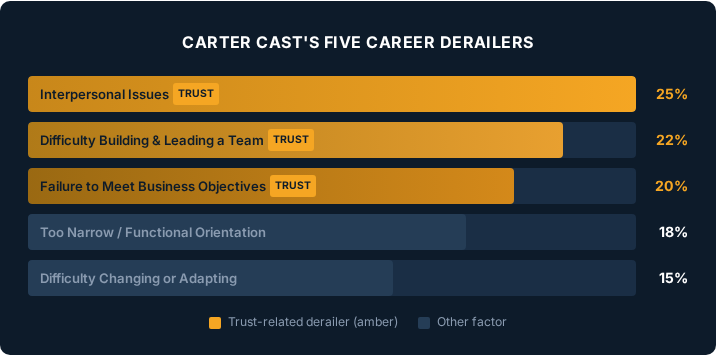
Carter Cast's research identified five major career derailers. Three of the five involve trust. The most common: interpersonal issues, led by arrogance, insensitivity, and poor listening.
Research from Chief Executive magazine found that professionals with inflated self-assessments and unaddressed blind spots are six times more likely to derail than those with accurate self-awareness. A study by Green Peak Partners and Cornell's School of Industrial and Labor Relations examined 72 executives at companies ranging from $50 million to $5 billion. High self-awareness was the strongest single predictor of overall success. More than any other variable in the study.
A leader who cannot be honest about how others experience them will keep winning on metrics while losing on relationships. At some point, the metrics are not enough.
Reason 4: You Do Not Know What You Are Worth
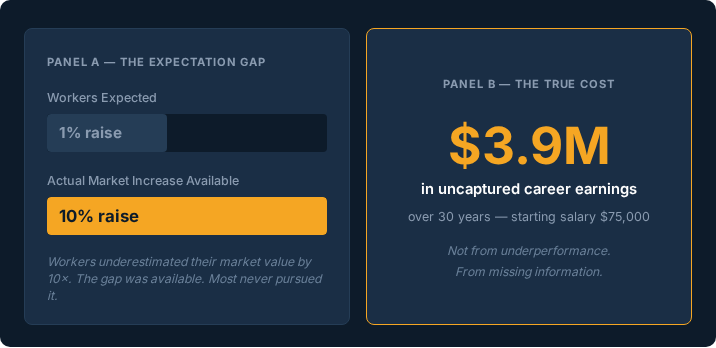
An MIT study published in the Quarterly Journal of Economics found that workers who would receive a 10% wage increase by switching firms expected only a 1% increase. Workers systematically underestimate their own market value. The gap comes from limited access to information, and most employees do not have what they need.
Lossdog's research found that a professional starting at $75,000 will leave approximately $3.9 million in uncaptured career earnings over 30 years, not due to underperformance, but because of structural information disadvantages in the labor market. Sixty-three percent of employees do not know their market value.
The professionals most vulnerable to this are often the ones who have been doing everything right. They invested in learning, in relationships, in contribution. They were not watching the market rate because the work was meaningful. That is admirable. Balance it with the discipline to know what the market says you are worth.
Reason 5: Mentors Are Not Enough
There is a real difference between a mentor and a sponsor.
Mentors speak with you. Sponsors speak for you in rooms you are not in.
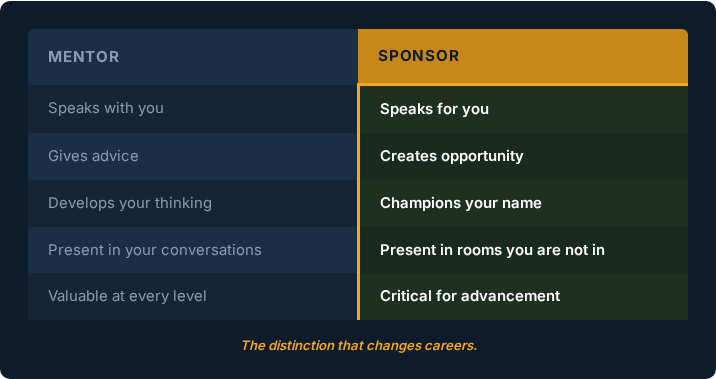
Research by Sylvia Ann Hewlett found that having a sponsor increases the likelihood of high-profile assignments, promotions, and salary increases by as much as 30%. A 2025 survey from Women of Influence+ found that 73% of sponsored professionals said it significantly accelerated their careers. And yet 41% cited lack of access to senior leaders as the primary reason they had never had one.
Building the right relationships is not networking for its own sake. It is making sure someone trusted at the decision table can put your name in the right conversation at the right time.
Here Is What I Chose
I want to be honest with you about something very personal, because this isn't abstract for me.
More than once in my career, I was handed an opportunity that would have put more money on the table. Real money. The kind that changes your immediate standard of living in ways you can see and measure.
I turned them down.
Each time, the reason was the same. The move would have uprooted my family. Pulled us away from people who matter. Disrupted something we had spent years building together. The relationships, the community, the life we were actually living, the definition of quality of life!
So I stayed. I kept growing where I was. I chose quality of life over standard of living!
And looking back across more than 25 years of building teams, transforming operations, and working alongside some of the most remarkable people in technology and aviation: my standard of living improved. It improved because I was patient. It improved because I kept investing in the right things.
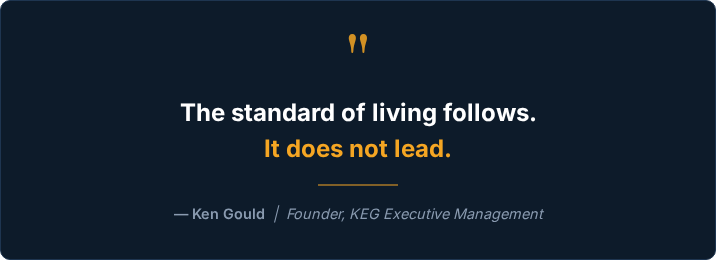
Ziglar was right. The standard of living follows. It does not lead.
The Honest View
Here is how the rules shift as you advance:
You are rewarded early for doing. Later you are evaluated on leading.
You are paid based on what your employer knows about the market. Not what you know.
You advance based on who champions your work. Not only the work itself.
You are trusted based on how others experience you. Not only your results.
You grow based on what you are learning. Not only what you already know.
Every one of these shifts is navigable. But only if you see them coming.
Here is the question worth sitting with: which objective have you actually been optimizing for?
— Ken Gould, Founder | KEG Executive Management | Fractional COO | Competitive Intelligence
Sources
Gallup State of the Global Workplace 2026 — gallup.com/workplace/349484
Gallup — Global Employee Engagement Continues Decline — gallup.com/workplace/708071
Forbes — The 2026 Ambition Recession (Vibhas Ratanjee) — forbes.com
Forbes — U.S. Employee Engagement Hits 10-Year Low (Roger Dooley, January 2025) — forbes.com
Tom Sosnoff — One Lucky Dog LIVE, Lossdog Network, May 14, 2026 — youtube.com
Carter Cast — Avoiding 3 Career Derailers, Northwestern Kellogg — youtube.com
Zig Ziglar — Goodreads verified quotes — goodreads.com
LinkedIn / CareerLabs — Skill x Visibility = Career Growth — linkedin.com
CareerLabs Podcast — Why Hard Work Is Not Getting You Promoted — amazon.com
Forbes — All Successful Leaders Need This Quality: Self-Awareness (Victor Lipman) — forbes.com
Chief Executive — Avoiding the Hubris Pitfall — chiefexecutive.net
MIT News — Study Finds Workers Misjudge Wage Markets, Jäger et al. (2024) — news.mit.edu
Grit Daily — Tom Sosnoff: $3.9M Uncaptured Earnings (Lossdog, 2026) — gritdaily.com
Lossdog — You Cannot Negotiate What You Cannot Quantify — lossdog.com
Forbes — Why Having a Sponsor Is Important (Sylvia Ann Hewlett / Bonnie Marcus) — forbes.com
Women of Influence+ — 73% of Sponsored Professionals Survey (2025) — womenofinfluence.ca
#CareerGrowth #Leadership #QualityOfLife #ZigZiglar #ExecutiveLeadership #FractionalCOO #CareerDevelopment #SMBGrowth #KEGExecutiveManagement #Operations